
[ad_1]
//php echo do_shortcode(‘[responsivevoice_button voice=”US English Male” buttontext=”Listen to Post”]’) ?>
Imec, a research center for nanoelectronics and digital technologies based in Leuven, Belgium, develops technology platforms to transmit and receive ultrasound waves in novel form factors. A typical application of ultrasound waves is sonography or echography—an imaging technique relying on capturing echoes of emitted ultrasound to produce high-resolution, 3D images of organs or structures deep in the body.
Applications of ultrasound, however, go far beyond imaging as focused ultrasound waves can be used to add touch—no gloves required—to extended reality to human machine interface (HMI), opening the door for improved treatments for chronic pain or Parkinson’s disease, Xavier Rottenberg, a fellow covering wave-based sensors and actuators at imec, told EE Times.
Sensors have gained a lot of attention in recent decades. They exist for all human senses and beyond, in everything including cameras, microphones, touch pads, LiDARs and spectrometers for gas analytics. Outside of displays and loudspeakers, little attention has been given to the development of actuators that play a crucial role in delivering energy and feedback to the target scene—for example, the human.
Research shows that vision and hearing encompass about 90% of the perception of people without perceptual disorders, Rottenberg said. Touch, in distant third place with only about 10% of overall perception, is still important and is a key driver for imec developments in ultrasound.

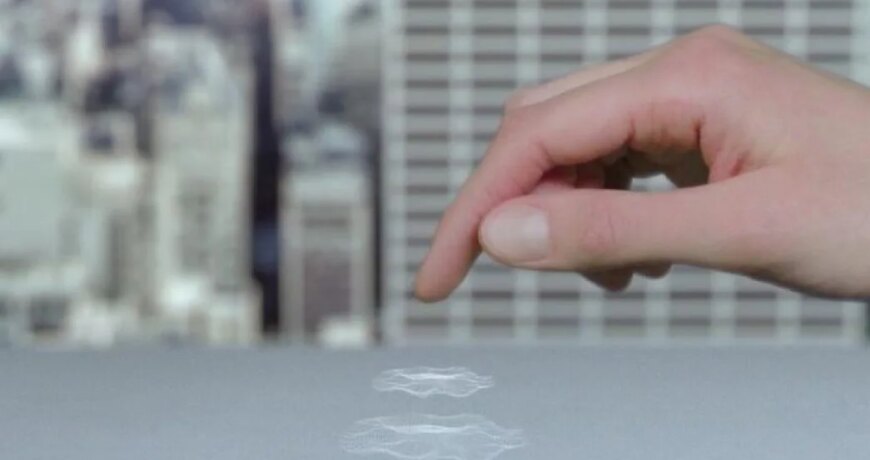
“Instead of imaging with ultrasound (as with diagnostic medical imaging), you can focus ultrasound with millimeter resolution at megahertz frequency… and you can modulate that focus point to trigger, for example, the receptors in your fingers causing them to tingle through haptic feedback without having to touch anything,” he said.
That is an especially relevant benefit now because, he added, “after the pandemic, people are less inclined to touch public and similar surface screens. If a smartphone could beam acoustic energy to my fingers, I would feel and interact with it without having to touch or even see the actual screen.”
In addition to addressing hygiene concerns, actuators could do away with worries about typing on a tiny phone or smart watch keypad; instead, people will be able to type and feel the keys on a large acoustic hologram produced by their smart device.
“Your smart phone screen is very nice, but sometimes too small for elderly people,” Rottenberg said. “Forget ever typing on your smart watch.”
Envision instead a cube of 30 by 30 by 30 centimeters projected in front of you—where you could type and “every time you type on the virtual keys, you get a formal local registration of your fingers to the virtual keyboard,” he said.
Focused ultrasound technologies can do much more than enhancing the extended reality user experience, Rottenberg added. Devices like smartphones are known to provide optical and acoustic stimuli. The addition of focused ultrasound technologies enables further haptic feedback, such as the actuation of the touch receptors.
For example, the same technique can be used to beam energy to the ears to enable directed sound, as well as to the peripheral nervous system to treat pain. It can also beam energy to the brain, laying the basis for a non-invasive, bi-directional brain-machine interface.
In the future, this technology could make it possible to detect epilepsy before external symptoms are present, as well as to treat Parkinson’s disease with focused ultrasound instead of the current surgical ultrasound treatment, according to Rottenberg.
The ultimate, long-term goal for imec is “to tap into the brain, in a non-invasive way,” he said. “We are trying to build an interface to all the senses. Ultimately you might want to tap into the central nervous system.”

Editor in Chief Brett Brune
Brett Brune is editor in chief of EETimes.com. He previously edited and reported business news at The New York Times, the Washington Post, and the Los Angeles Times. He also previously served as editor in chief of SmartGridToday.com, as well as Smart Manufacturing magazine.
[ad_2]
Source link
